What happens to Australian property investors if interest rates stay higher for longer?

Not necessarily. The greater risk may be what prolonged restrictive monetary policy is doing beneath the surface of Australia's credit and funding system.
Most commentary around Australian property currently centres on one question: what will the RBA do next?
Will rates rise? Will they hold? When will they fall?
For property investors, that may be too narrow a way to read the cycle.
Our research suggests the more important question is whether Australia's cash rate, credit conditions, liquidity and funding system are continuing to move in step.
When they stop doing so, history suggests the underlying financial system can become more sensitive - even if the headline economic numbers still appear relatively orderly.
That distinction matters for investors carrying debt, considering another acquisition or determining how resilient their portfolio would be
through the next stage of the cycle.
What is financial fragility?
Financial fragility describes the sensitivity building within the funding and credit system as liquidity, consumer credit and the structure of debt change.
Ramsey Property Wealth's Property Economics & Intelligence team developed a monthly Australian Financial Fragility Composite covering Australian business cycles since 1990.
Rather than looking at one economic measure in isolation, the model combines four funding-system indicators:
- the ratio of short-term to long-term non-government debt securities;
- personal credit as a share of broad money;
- personal-credit growth; and
- negated broad-money growth.
Each measure is standardised over a rolling 12-month period and combined into a single composite.
A higher reading indicates a system relying more heavily on short-term funding, carrying stronger consumer-credit activity and receiving less support from liquidity growth.
The purpose isn't to predict the next RBA decision.
It is to understand how the financial system is responding to monetary policy.
Why isn't the RBA cash rate enough to understand the property market?
Because the cash rate tells us the policy setting. It does not tell us how the financial system is absorbing it.
Two periods with the same cash rate can produce very different economic and property conditions.
Borrowing capacity, household credit, liquidity, the availability of funding and lenders' willingness to extend credit can all change independently of the headline rate.
This is why we believe investors should pay attention to co-movement.
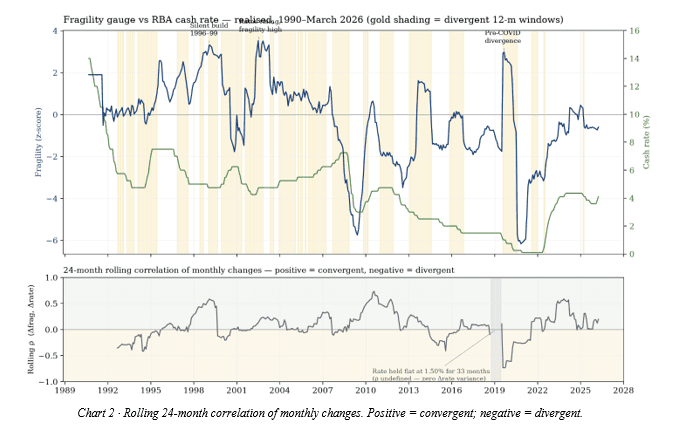
When the cash rate and financial-fragility gauge move broadly together, we describe the environment as convergent.
When they begin moving in opposite directions, the environment becomes divergent.
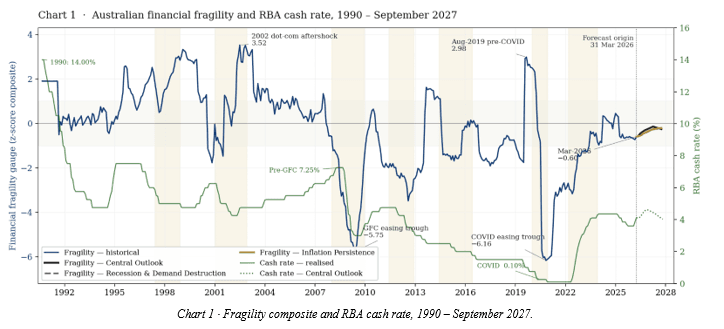
Historically, some of the highest readings in our fragility composite occurred during divergent periods. The gauge peaked at 3.52 in 2002 and 2.98 in August 2019 while interest rates were being cut or held low.
That leads to an important point for investors:
Falling interest rates do not automatically mean financial conditions are improving.
Sometimes the reason rates are falling matters considerably more than the cut itself.
Is Australia's financial system currently under stress?
Our research does not suggest Australia is presently in a divergent regime. The current cycle remains convergent — but some of the apparent improvement warrants closer examination.
From May 2022, the RBA cash rate rose from 0.10% to 4.35%, while Ramsey's fragility gauge recovered from its COVID-era trough of -6.16 to approximately -0.60 by March 2026.
On the surface, that represents a relatively orderly response.
The 24-month rolling correlation at March 2026 remained positive: +0.84 in levels and +0.20 in first differences.
But that relationship has been softening.
More importantly, our decomposition indicates that roughly three-quarters of the recovery in the fragility gauge can be attributed to the mechanical unwinding of COVID-era base effects.
Broad-money growth decelerated from approximately 12% to 7%, while personal-credit growth moved from a 13% contraction to approximately 4% expansion.
Only the remaining quarter of the improvement reflects underlying changes in funding channels.
So the headline reading deserves context.
The system has improved substantially from its extraordinary COVID-era position, but that does not necessarily mean the underlying adjustment is complete.
What happens if Australian inflation stays high?
There is no single answer because the type of inflation environment matters.
Our research models three possible regimes.
1. Inflation moderates in an orderly way
Under our Central Outlook, inflation gradually moderates and monetary policy remains sufficiently aligned with the funding and credit system.
The financial-fragility regime remains convergent.
For investors, this would represent the more orderly pathway: restrictive conditions gradually work through the economy without a major breakdown between policy and financial conditions.
2. Demand weakens sharply
A different scenario emerges if demand contracts while supply-side inflation remains.
The RBA may eventually need to reduce rates in response to weaker demand, but personal-credit contraction and short-term funding pressures could continue to increase financial fragility.
Under Ramsey's modelling, this scenario produces divergence from the second quarter of 2027.
3. Inflation remains persistent
Persistent inflation creates another challenge.
Monetary policy may need to remain restrictive for longer, compressing liquidity and broad-money growth.
Eventually rates may begin to fall, but a modest easing may not immediately reverse the effects of an extended restrictive period.
Again, the result can be a divergence between the cash rate and underlying financial fragility.
The important point is that a future rate cut is not, by itself, the signal investors should be waiting for.
Will Australian interest rates fall?
Interest rates can eventually fall under very different economic circumstances.
That is why asking when rates will fall is less useful than asking why they are falling when they do.
A rate cut occurring because inflation has moderated while credit and liquidity conditions remain healthy is very different from a rate cut occurring because demand, credit creation or financial conditions have deteriorated.
Our historical analysis identified periods in which financial fragility continued to rise despite monetary-policy easing.
Between 2017 and 2019, for example, the RBA cut rates by 75 basis points while the fragility gauge climbed substantially.
For property investors, lower rates should therefore be interpreted alongside the conditions that caused them.
What should property investors watch instead of just the RBA cash rate?
Property investors don't need to ignore interest rates. They need to stop treating them as a complete economic signal.
We believe five questions deserve attention:
- Inflation: Is inflation genuinely moderating, or proving persistent?
- Credit: Is household and personal credit expanding or contracting?
- Liquidity: Is broad-money growth supporting or constraining the financial system?
- Funding: Is the system becoming increasingly dependent on shorter-term funding?
- Co-movement: Are financial conditions continuing to move with monetary policy, or beginning to move against it?
The final question is particularly important.
Our research suggests that the direction of the relationship can tell us more than the absolute level of an individual indicator.
What does a higher-for-longer rate environment mean for a property portfolio?
For property investors, this research shouldn't be interpreted as a prediction to buy, sell or wait.
It should change the way a portfolio is tested.
A portfolio strategy that only works if interest rates fall soon is making a macroeconomic bet.
A more resilient strategy asks:
Can a property portfolio continue to function if borrowing costs remain restrictive?
Is there sufficient cash-flow capacity if holding costs remain elevated?
Does the lending structure preserve borrowing capacity and optionality?
Is each asset still performing the role it was acquired to perform?
Can the investor continue executing their long-term strategy without requiring the next RBA decision to go their way?
That is a very different standard from simply asking whether rates have peaked.
Is another Australian interest-rate rise possible?
Our research does not rule it out.
The modelling considers non-central scenarios in which the cash rate moves above 5% before subsequently easing.
However, there is also a limit to how far monetary policy can tighten before stress within the funding and credit system begins to reduce its effectiveness.
As the original research argues, the practical ceiling on monetary tightening may ultimately be determined not only by the inflation objective, but by the financial system's ability to continue absorbing restrictive policy.
This is precisely why monitoring both sides of the equation matters.
What is the outlook for Australian property investors?
There is no single cash-rate number that determines what happens next.
The more useful question is whether inflation, monetary policy and Australia's funding and credit system continue moving in step.
For now, our financial-fragility model indicates that the regime remains convergent.
The risk to watch is a turn towards divergence.
Historically, changes in that relationship have appeared before the stress became obvious in any single headline indicator.
For property investors, that reinforces a principle we consider fundamental:
Don't build a portfolio around a forecast of the next interest-rate move. Build one capable of operating across multiple economic scenarios.
Article Contributors
.png)
Written By:
Ewan Ramsey
Founder,
Director and Investor
PhD research conducted by:
Dr Prabath
Morawakage - PhD, CPA
PhD, Real Estate Finance and Economics at Ramsey
General information only. This material does not constitute personal financial, credit, tax or investment advice. Ramsey Property Wealth Pty Ltd | ACR 389087.