Australia’s Economic Uncertainty Is Lasting Longer. What Does It Mean for Property Investors?
.png) Australia
has lived through plenty of economic shocks over the past three decades: the Global Financial Crisis, COVID-19, geopolitical conflict,
rapid changes in interest rates and periods of significant policy change.
Australia
has lived through plenty of economic shocks over the past three decades: the Global Financial Crisis, COVID-19, geopolitical conflict,
rapid changes in interest rates and periods of significant policy change.
What’s unusual about the current period isn't simply the level of uncertainty. It is how long that uncertainty is taking to work its way through the Australian economy.
Our latest research suggests Australia is becoming slower to absorb economic and policy shocks than it was in previous cycles.
For property investors, this matters. Decisions around borrowing, investing and holding property are being made against an environment where interest rates, tax settings, migration, global events and household finances are interacting at the same time.
The question, then, isn't simply when conditions will settle.
It is whether your investment strategy can comfortably operate while they remain unsettled.
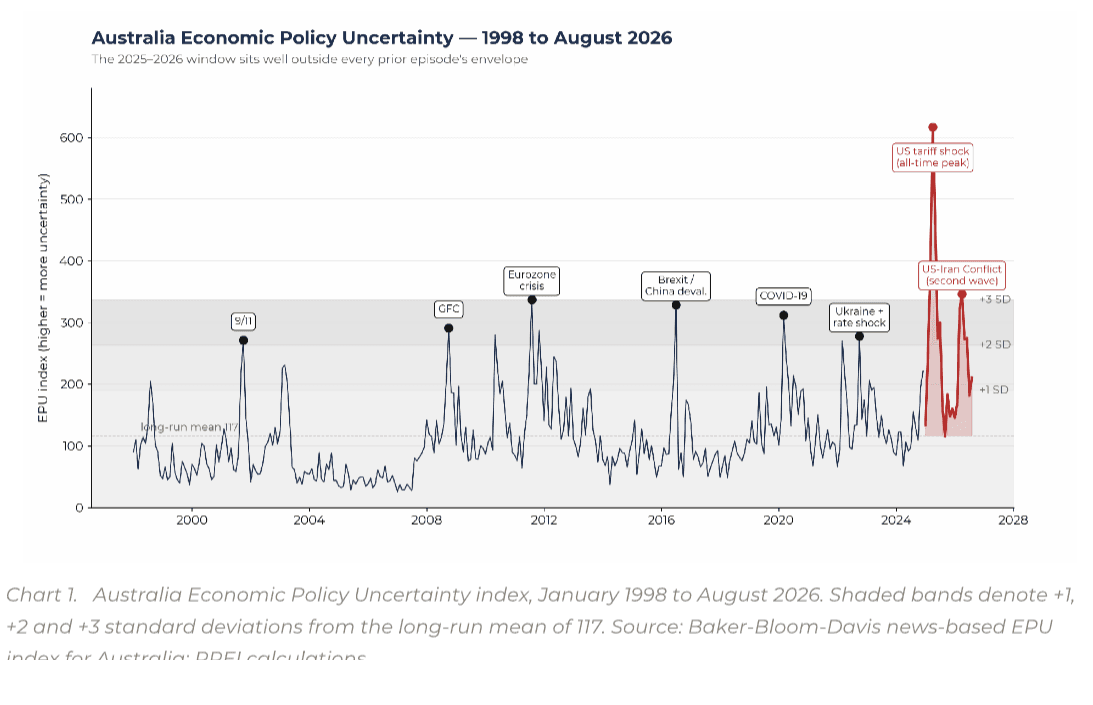
Australia’s uncertainty reached a historic high
The Economic Policy Uncertainty Index tracks the prevalence of economic and policy uncertainty in news coverage over time.
In April 2025, Australia's index reached 617 - the highest monthly reading in the 28 year Australian series.
That spike wasn't uniquely Australian. Europe reached 779 in the same month and the United Kingdom reached 498, as economies around the world responded to the same tariff and election-related shock.
What makes Australia's experience more interesting is what happened next.
Nine of the 20 highest uncertainty readings in Australia's recorded history have occurred since March 2025. A second wave in March and April 2026 pushed the Australian index back above three standard deviations from its long-run average.
Australia Economic Policy Uncertainty, 1998–August 2026
Other economies have moved on faster
A spike in uncertainty isn't necessarily a problem in itself. Economies absorb shocks and recover from them.
The more useful comparison is how quickly that happens.
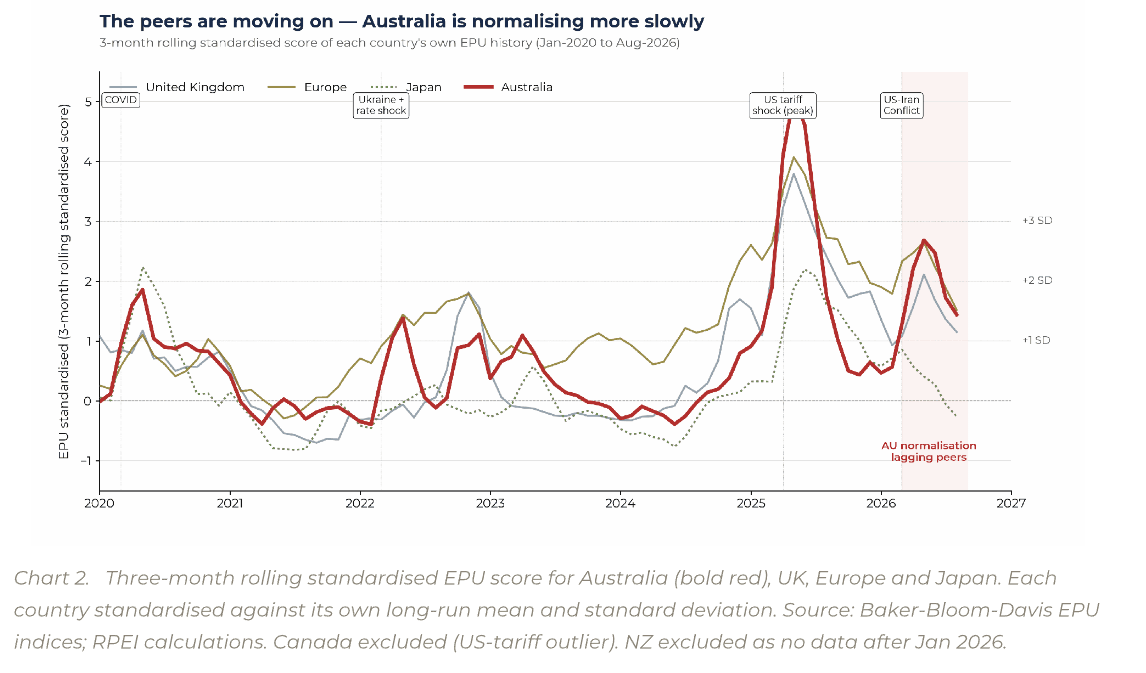
When we compared Australia with Europe, Japan and the United Kingdom, all four economies had begun moving back towards their own historical averages. Australia, however, was doing so more slowly.
Measured from each country's 2025 average to August 2026, the reduction in uncertainty was:
- Europe: 1.64 standard deviations
- Japan: 1.61
- United Kingdom: 0.92
- Australia: 0.76
Australia has therefore retained more of its 2025 elevation than the three peer economies included in the analysis.
Australia compared with UK, Europe and Japan
That leads to what we think is the more significant finding.
A shock that once faded quickly now takes around six months
We used a statistical model to estimate the half-life of an economic uncertainty shock.
In everyday terms, this measures how long it takes for half the effect of a shock to fade.
At the end of 2012, the estimated half-life in Australia was around one month. At the end of 2019, it was approximately two months.
By August 2026, it was approximately six months.
When we applied the same methodology to the United Kingdom, Europe and Japan, none showed a comparable deterioration.
Australia's shock-absorption capacity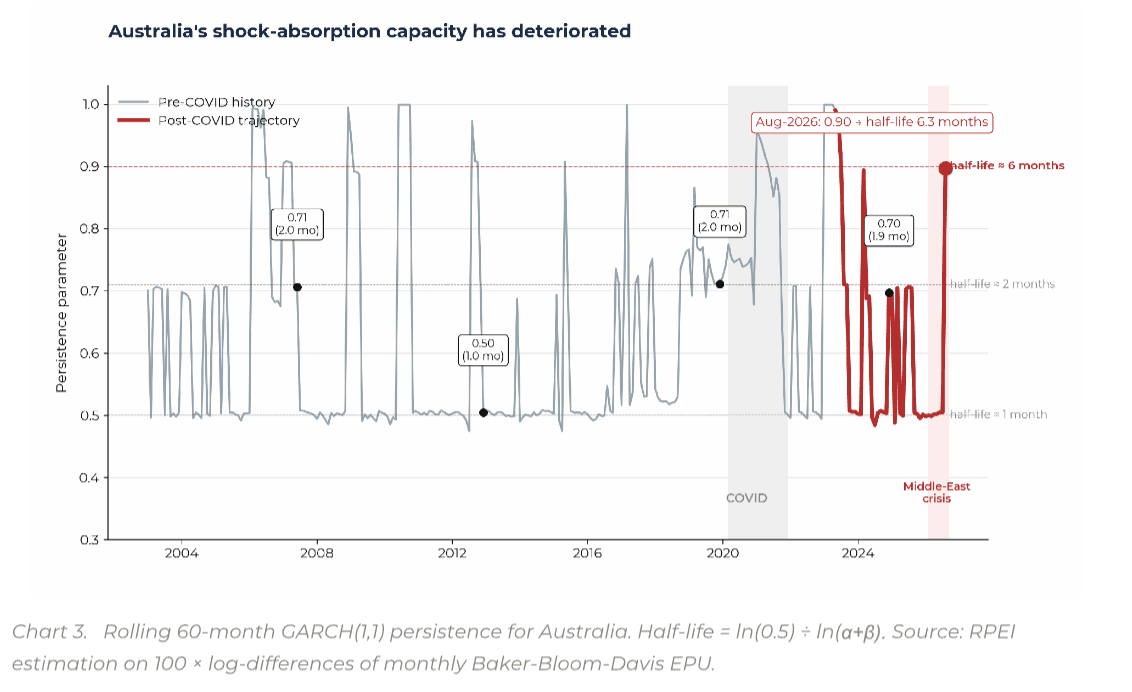
This is an important distinction.
Markets can deal with a sharp event that passes quickly. Businesses and households can defer decisions for a month or two while they wait for more information.
It becomes harder when uncertainty lingers.
Why does that matter?
A business considering a five-year investment doesn't only care about how uncertain conditions are today. It cares about how long those conditions are likely to continue.
The same applies to a household taking on a 30-year mortgage or an investor deciding whether their portfolio can support another acquisition.
When uncertainty persists, delaying a decision can start to look more attractive.
Businesses may defer investment. Employers can become more cautious about hiring. Households may hold larger cash buffers. Borrowers can become more conservative.
Reserve Bank research has previously identified business investment, employment decisions and precautionary household saving as three channels through which uncertainty affects economic activity.
There are signs of pressure in the current Australian data as well. The underlying research records weaker real wages, a contraction in business investment and consumer sentiment remaining below its neutral threshold.
For property investors, that broader economic backdrop matters because property doesn't operate independently of household finances, credit
markets, employment or business confidence.
Australia is carrying a heavier load
There is another reason the current cycle deserves attention.
Australia isn't absorbing today's shocks with the same household and government balance sheets it had during earlier periods of volatility.
The household mortgage stock has increased from approximately 77% of annual GDP in June 2007 to 87% in the latest reading used in
our analysis.
Long-term Commonwealth debt securities on issue increased from approximately $115 billion in June 2007 to $1.698 trillion by March 2026.
Real GDP per person remains below its mid-2022 level, while labour productivity has remained around its late-2019 level for six years.
Aggregate housing credit also contracted month-on-month in March 2026 — the first contraction in the history of the series used in the research.
None of these factors tells us what will happen to property prices next.
They tell us something different: the conditions into which today's economic and policy decisions are landing have changed.
A movement in interest rates or a change in tax policy can have a very different effect on a highly leveraged household sector than it would
have had when household balance sheets had more room to absorb it.
How much of this uncertainty is actually Australian?
Not all of it.
Australia is a globally connected economy and will inevitably import uncertainty through trade, financial markets, commodity prices and global events.
Our analysis attempts to separate these effects.
Across the full dataset, approximately 66% of the variation in Australian economic policy uncertainty was generated by Australian shocks and 34% was imported from the international peer group.
That balance has changed.
In the post-COVID period, the domestic share has fallen to approximately 59%, while the imported component has risen to more than 40%.
Domestic versus imported uncertainty
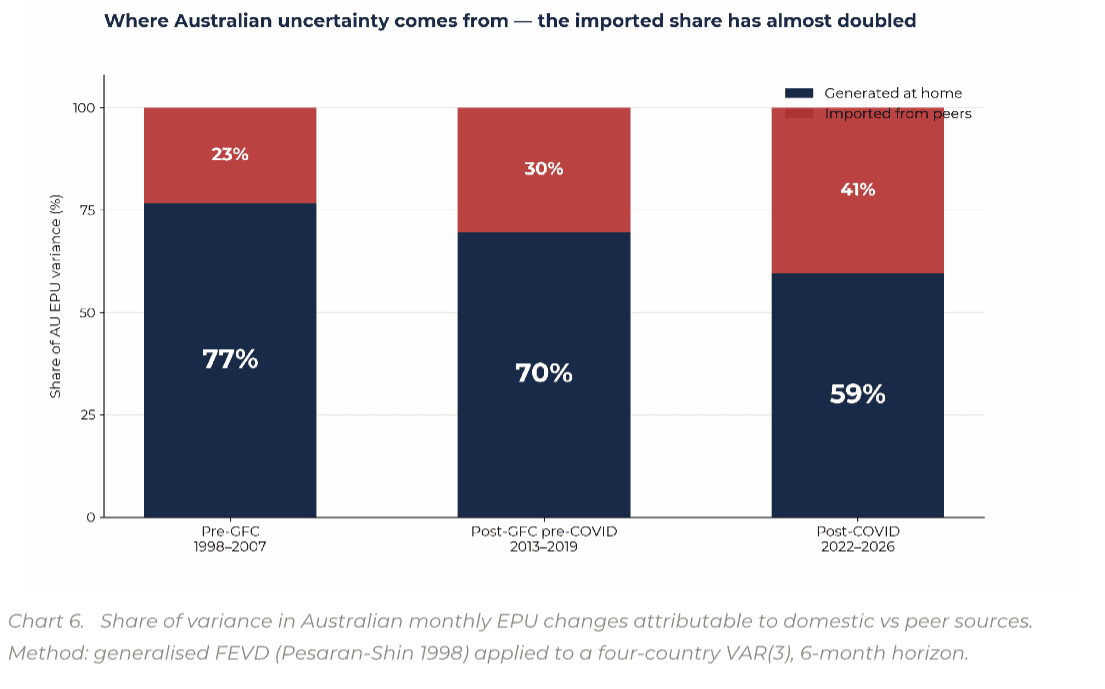
Australia has become more exposed to the global uncertainty environment.
But the majority of the variation in the Australian series is still domestic.
That distinction is important because Australia has little influence over an overseas conflict, foreign election or international trade
dispute. Domestic policy settings are different.
Why has 2026 been different?
There isn't one single explanation.
Rather, several major economic forces have been moving at the same time.
Monetary policy has changed. Fiscal and tax settings have changed. Migration settings have moved. Those domestic changes have coincided with significant international disruption, including sharp movements in energy markets during 2026.
Australian financing conditions had also begun repricing before some of those external events intensified.
Each change can be considered independently.
For households, businesses and investors, however, they don't arrive independently. They land together.
That is where the cumulative effect becomes important.
What does this mean for property investors?
This research isn't a forecast of where Australian property prices go next.
Economic uncertainty alone cannot tell us whether a particular property market will rise or fall. Property performance remains heavily influenced by local supply and demand, affordability, employment, population, credit availability, infrastructure and the characteristics of the individual asset.
What the research does tell us is that investors should be careful about building a strategy around the assumption that today's conditions will quickly disappear.
If uncertainty is persisting for longer, a portfolio needs enough resilience to do the same.
That brings borrowing capacity and cash flow into sharper focus. An investment shouldn't depend on financing conditions quickly returning to where they were previously.
Portfolio structure matters too. Changes to lending, tax and policy settings become more consequential as a portfolio grows, particularly when decisions made today need to remain workable for many years.
And asset selection becomes increasingly important.
A national property result can hide very different outcomes at state, city, suburb and property level. In a more uncertain environment,
understanding the economic drivers beneath an individual market becomes more useful than relying on a national headline.
The question investors should be asking
There will always be uncertainty in property investment.
Waiting for every economic indicator, interest rate decision and government policy to become clear before making a decision isn't a realistic investment strategy.
But neither is assuming that difficult conditions will disappear quickly.
The more useful question is:
If today's conditions last longer than expected, does my strategy still work?
Can the portfolio carry its debt comfortably? Is there sufficient cash-flow capacity? Is the ownership and lending structure appropriate? Are the assets being selected for identifiable economic reasons rather than simply because a market is currently rising?
Those questions are important in any market.
Our research suggests they matter particularly now.
Australia hasn't lost its ability to absorb economic shocks. But the evidence suggests it is taking longer to do so.
For long-term property investors, that is worth understanding.
Ramsey Property Wealth's Portfolio Strategy and Structure Review examines property performance, lending, cash flow, equity, risk and
progress towards the investor's longer-term goals.
The advice we provide is not tied to purchasing another property and to access this service and assess your current property portfolio we
encore astute investors to book a complimentary call below:
Article Contributors
.png)
Written By:
Ewan Ramsey
Founder, Director and Investor
PhD research conducted by:
Dr Prabath Morawakage - PhD, CPA
PhD, Real Estate Finance and Economics at Ramsey
General information only. This material does not constitute personal financial, credit, tax or investment advice. Ramsey Property Wealth Pty Ltd | ACR 389087.